Azeroth: Difference between revisions
→Geography: First pass for the Eastern Kingdoms |
Design note about the name Azeroth |
||
| Line 79: | Line 79: | ||
File:WorldMap-turtle.jpg|[[Turtle WoW]] as of [[Patch 1.18.1]] | File:WorldMap-turtle.jpg|[[Turtle WoW]] as of [[Patch 1.18.1]] | ||
</gallery> | </gallery> | ||
==Design Notes== | |||
Blizzard clearly has a love for the name "Azeroth", moving from kingdom to subcontinent to planet. In order to make it logical within the setting, I assume that something happened like this: | |||
#Humans move south and name the general area Azeroth. | |||
#These humans form the Kingdom of Azeroth. | |||
#The kingdom's name spreads to encompass all of the southern lands due to being the major power. | |||
#The kingdom falls and is later reestablished as the Kingdom of Stormwind, named for the city that was first reconquered, but the name of the region stays the same. | |||
#The name spreads in time to cover more and more areas due to the political influence of the Alliance. | |||
#Other continents and worlds become known due to the Third War, creating a lexical gap. | |||
#The name becomes applied to the planet among speakers of Common, likely spreading from there. | |||
Prior to the revelation that demons are consuming countless worlds, names for the planet were likely fairly generic, such as simply "the world". This new designation for the planet is probably fairly common among Common speakers and now likely growing in usage in Dwarven, Gnomish, and Thalassian, at least within the populations a part of the Alliance. There is probably a plurality of speakers within the Ashen Covenant who uses the word due to shared languages between the two major factions. The Horde and the Guardians of Hyjal likely follow an entirely different naming scheme, but it is believable that some orcs might have inherited the word from working with humans at the end of the Third War. | |||
==Endnotes== | ==Endnotes== | ||
<references /> | <references /> | ||
[[Category:World]] | [[Category:World]] | ||
Revision as of 1:07 PM, September 4, 2026

Azeroth is the name of the world in which the majority of the Warcraft series is set. The world of Azeroth is the birthplace of many races, most notably elves (night elves, high elves, and blood elves), humans, dwarves, tauren, goblins, trolls, gnomes, and dragons.
Geography
The world of Azeroth comprises three major continents with a number of islands scattered about them. The Great Sea is located between the three landmasses and has at its center the Maelstrom—a tumultuous storm of tidal fury and chaotic energies born of the destruction of the Well of Eternity.[1]
Before the War of the Ancients, all these continents and islands were one single landmass known as Kalimdor. At the end of the war with the implosion of the Well causing the Great Sundering, the landmass shattered into three continents, while the sunken land in between became the Great Sea.
The Forbidding Sea is the expanse of water to the east of the Eastern Kingdoms. The Veiled Sea sits west of Kalimdor.
Eastern Kingdoms
To the east lie the Eastern Kingdoms, which is made up of three major regions: Azeroth to the south, Khaz Modan in the middle, and Lordaeron to the north, these last two being separated by a channel and connected by the dwarven bridge of Thandol Span.
- Lordaeron
- Alterac Mountains
- Alterac Valley
- Arathi Highlands
- Blackened Woods (formerly Quel'Thalas)
- Crestfall (island between Tol Barad and Kul Tiras)
- Gilneas
- Highlands
- Hillsbrad Foothills
- Hinterlands
- Kul Tiras (island off southwest coast)
- Plaguelands (formerly Eastweald)
- Silverpine Forest
- Thalassian Lowlands
- Tirisfal Glades
- Tol Barad (island in Baradin Bay)
- Zul'Dare (island between Hillsbrad Foothills and Kul Tiras)
- Khaz Modan
- Azeroth
- Ashlands
- Balor (island off northwest coast)
- Blasted Lands (formerly the Black Morass)
- Burning Steppes
- Deadwind Pass
- Duskwood
- Elwynn Forest
- Gillijim's Isle (island west of Stranglethorn Vale)
- Lapidis Isle (island west of Stranglethorn Vale)
- Northwind
- Redridge Mountains
- Stranglethorn Vale
- Swamp of Sorrows
- Westfall
Kalimdor
To the west is Kalimdor, which is further divided into Northern Kalimdor, Central Kalimdor, and Southern Kalimdor.
- Northern Kalimdor
- Central Kalimdor
- Southern Kalimdor
Northrend
North of Great Sea lies the frozen continent of Northrend, the roof of the world.
Orbit
Azeroth has two moons: the larger White Lady and the smaller Blue Child.
Meteors have crashed onto the surface previously, such as in Moonwhisper Coast.[2]
Gallery
-
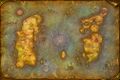 Turtle WoW as of Patch 1.18.1

Design Notes
Blizzard clearly has a love for the name "Azeroth", moving from kingdom to subcontinent to planet. In order to make it logical within the setting, I assume that something happened like this:
- Humans move south and name the general area Azeroth.
- These humans form the Kingdom of Azeroth.
- The kingdom's name spreads to encompass all of the southern lands due to being the major power.
- The kingdom falls and is later reestablished as the Kingdom of Stormwind, named for the city that was first reconquered, but the name of the region stays the same.
- The name spreads in time to cover more and more areas due to the political influence of the Alliance.
- Other continents and worlds become known due to the Third War, creating a lexical gap.
- The name becomes applied to the planet among speakers of Common, likely spreading from there.
Prior to the revelation that demons are consuming countless worlds, names for the planet were likely fairly generic, such as simply "the world". This new designation for the planet is probably fairly common among Common speakers and now likely growing in usage in Dwarven, Gnomish, and Thalassian, at least within the populations a part of the Alliance. There is probably a plurality of speakers within the Ashen Covenant who uses the word due to shared languages between the two major factions. The Horde and the Guardians of Hyjal likely follow an entirely different naming scheme, but it is believable that some orcs might have inherited the word from working with humans at the end of the Third War.